Created with Sketch.

Can I Hug All These Flowers?

Ali Eyal

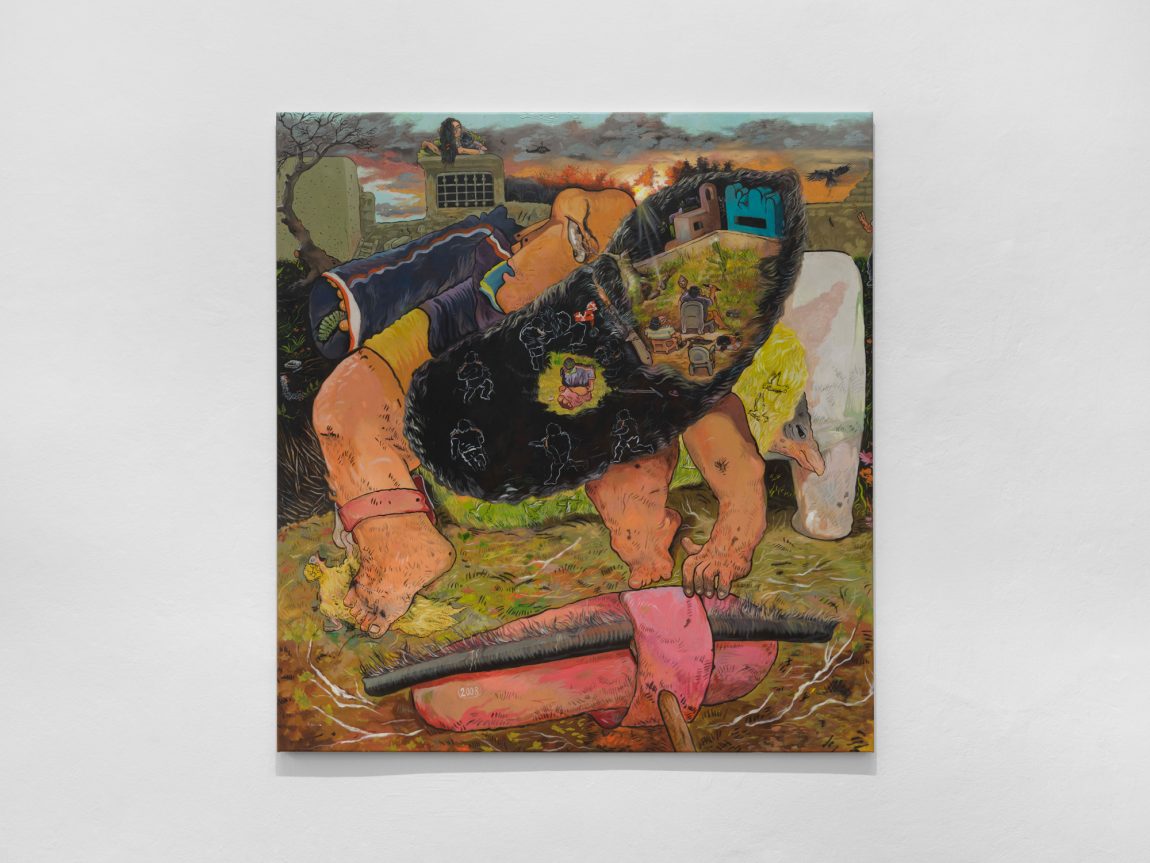
From then on, doves scare me, 2024. Oil on canvas. Courtesy of the artist and ChertLüdde, Berlin.

From then on, doves scare me, 2024
Oil on canvas

Ali Eyal’s distinctive painting technique is marked by intricate layers of brushstrokes and superimposed figures and text, creating compositions rich in depth and meaning. A recurring motif in his work is a dark head of hair, which serves as a vessel for fragmented memories. This element is deeply personal, recalling childhood moments when Eyal would run his fingers through his mother’s hair as she told him stories. Now, as a storyteller in his own right, Eyal integrates everyday objects into his paintings as symbols of memory and life, seamlessly blending characters with backgrounds that embody their recollections.

This particular composition is a self-portrait, in which Eyal revisits a childhood memory of accidentally stepping on and killing a dove. In the top right corner, a crow appears in flight, being fed peanuts by his friend and fellow artist David Horvitz.

This work was first presented in David Horvitz’s 7th Avenue Garden in Los Angeles.

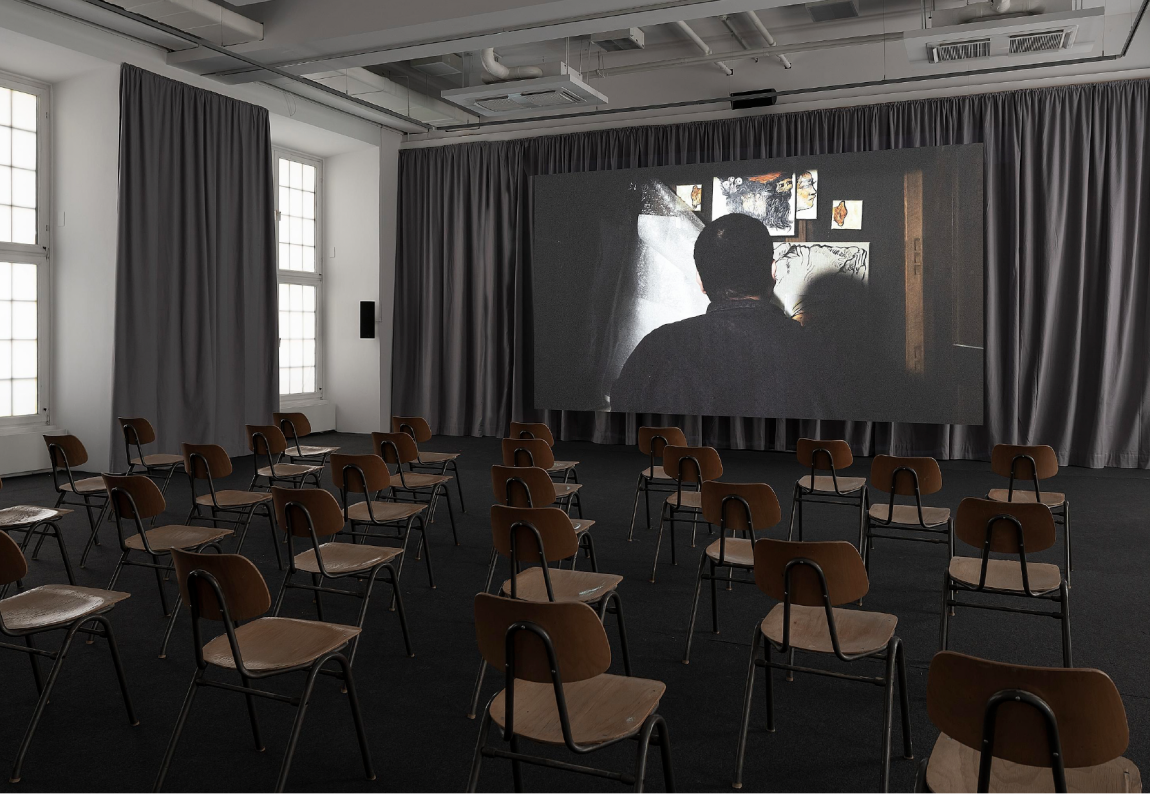
The Blue Ink Pocket, and., 2022. Courtesy of the artist and ChertLüdde, Berlin.

The Blue Ink Pocket, and., 2022
Video,11 min

Editor and camera operator: Issac Lythgoe
Consulting editor: Mary Jirmanus Saba
Sound mix : Ernst Karel
Colorist: Belal Hibri

In the village we managed to retrieve from a number of different houses the lost pieces of the artist’s roving duplicates. They wanted to send these pieces to local museums.

The village artist drew copies of himself with complicated stories that he shared in the galleries from around the world, since he couldn’t travel with his duplicates because of the migration of furniture, friends, and trees. This was both an artistic style and his position towards the politics that obstruct the movement of the artist with his work and his western audience. He had a group of drawings of the strongest passports from around the world that he accomplished with cheap paints on cigarette boxes. He formed with each story a duplicate of himself where he placed a passport in the pocket of the drawn shirt. This copy of “The Blue Ink Pocket” is the only one we possess.

Aside from an old letter that the artist wrote in 2022 for a collective he joined, nothing remains except the signature and the phrase “Good luck.” The words were consumed by the farm’s larvae in the basement. But it’s possible for you to see the traces of the pen’s power on the back of the paper, and you read:

What if you were an artist in the Battle of Karbala? What then? This was the first question that was brought up in our Sada lectures by a distant international artist through Skype in an old building. On the way to the lecture, we navigated car bombs. When we arrived, our eyes were puffed up as though from jungle mosquitos. While the question was intriguing, we never found an answer as to how to document the Battle of Karbala artistically. Our ages ranged from fifteen to sixteen, a small group from the art institute, with an additional group from the Baghdad university’s art department. There wasn’t an advanced level of art education, for this reason, this group was a small advanced school for Baghdad’s emerging artists.

When I joined art residencies, they both destroyed the chains of traditional academic training that I had been through at the Institute of Fine Arts.

With Sada, I was introduced to video and other experimental forms. In Ashkal Alwan, Beirut, I decided to return to painting, in a way critical to the traditional forms. I stopped drawing and painting for years before joining the artistic group in Beirut. All because the person who had taught me painting…here a piece of the text is incomprehensible.

I realized that painting could bring me to courtroom drawings, which are rapidly accomplished, paintings that double as tools of witness, and for this reason sometimes the outlines connect and sometimes they do not.

Don’t you see this canvas as a shroud or a curtain that covers the painting-in-hiding.

The painting’s wood contains the tree’s voice, cast out like me from far off forests.

Sometimes I work directly without use of wood or an outer frame, so it gives freedom to the canvas to take a ghost shape. Painting and drawing contain a lot of baggage, but this is also its power. This medium fits the life of the immigrant, since three exhibitions fit in one piece of luggage.

Good Luck Ali Eyal
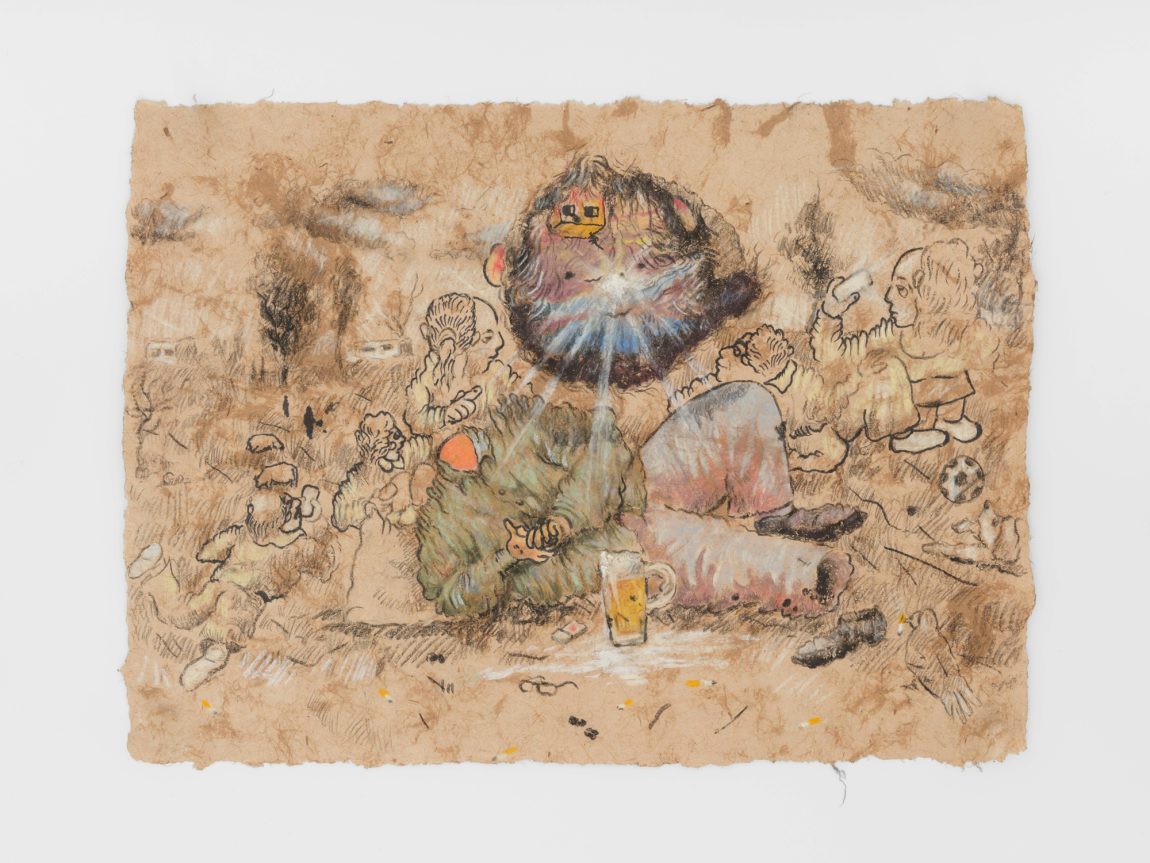
A lovely spot for a picnic. it's a very quiet area, but I will not tell you which park, 2024 Pastel pencils on Amate paper. Courtesy of the artist and ChertLüdde, Berlin.

A lovely spot for a picnic. it’s a very quiet area, but I will not tell you which park, 2024
Pastel pencils on amate paper

Ali Eyal’s distinctive painting technique is characterized by intricate layers of brushstrokes, interwoven figures, and text, resulting in compositions rich with depth and meaning. In this drawing, the artist’s reclining body appears in a park, surrounded by scattered objects and memories that disrupt the composition’s flow. True to Eyal’s signature style, a black head of hair serves as a vessel for fragmented memories of the past.

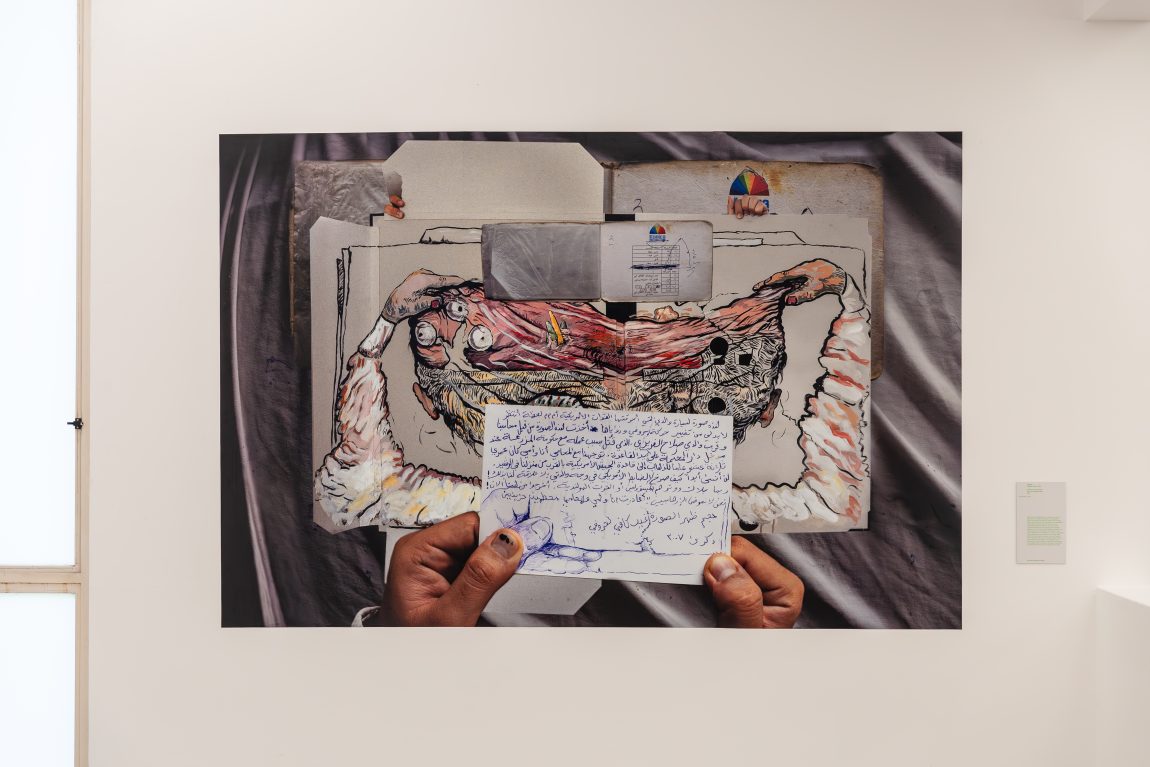
Ali Eyal, 6x9 doesn’t fit everything and., 2021, 182.88 × 274.32 cm, Installation view of 14th Mercosul Biennial, Curated by Raphael Fonseca, 2025, Photo by Thiele Elissa, Courtesy of the artist and ChertLüdde, Berlin

6×9 doesn’t fit everything and., 2021
Photograph printed on adhesive paper

The following is the translation of the Arabic text that appears in the image:

“This is a photograph of my father’s car which was burned by the American forces, umm wait, I have to change the accents and angles of my letters. This photograph was taken by our lawyer and my father’s relative Salah Al-Ghrairi, who was murdered, due to his work with the Farm government, by Al-Qaeda at the doorsteps of the court building. We headed out with the lawyer, I and my mother, when I was thirteen years old, and went to the American Military base near our house in Al-Rashid. I will never forget how the American soldier yelled in my mother’s face: ‘We have nothing to do with that! It could have been Blackwater or the Dutch Forces. Now get out! We don’t compensate terrorists.’ I left with my mother and the lawyer devastated and heartbroken. The size of the photograph’s back is not enough for my letters. Memory from 2007.”

Ali Eyal’s work explores the relationships between the way catastrophes are remembered, and the identity and politics of Iraq and the Arab world (for which he uses the metaphor “Small Farm”), particularly after the 2003 American-led invasion.

In the bloody aftermath of the invasion, Eyal lost his father and several uncles, who disappeared in 2006, leaving behind only a photograph of a firebombed Daewoo Prince. The car could have been destroyed by the American military, private security contractors (such as Blackwater), or other foreign forces. At the centre of the work presented here is this photograph, the content of which is denied to viewers, who can only access the inscription on the back. But the photograph is seen as one of numerous layers, composed of sketches, albums, and open folders (implying an unresolved case), and the artist does not reveal whether these point to real or imagined objects and events.

The work raises questions about the impossibility of reconciling attempts to document or remember with the vast scale of the tragedies brought about by conflict— which often escape the frames into which one might wish to inscribe their multiple, and often inconceivable, dimensions. (Amin Al Saden). 

Ala Younis

Battles in a Future Estate, 2021-ongoing.

Battles in a Future Estate, 2021. Video, 44 mins

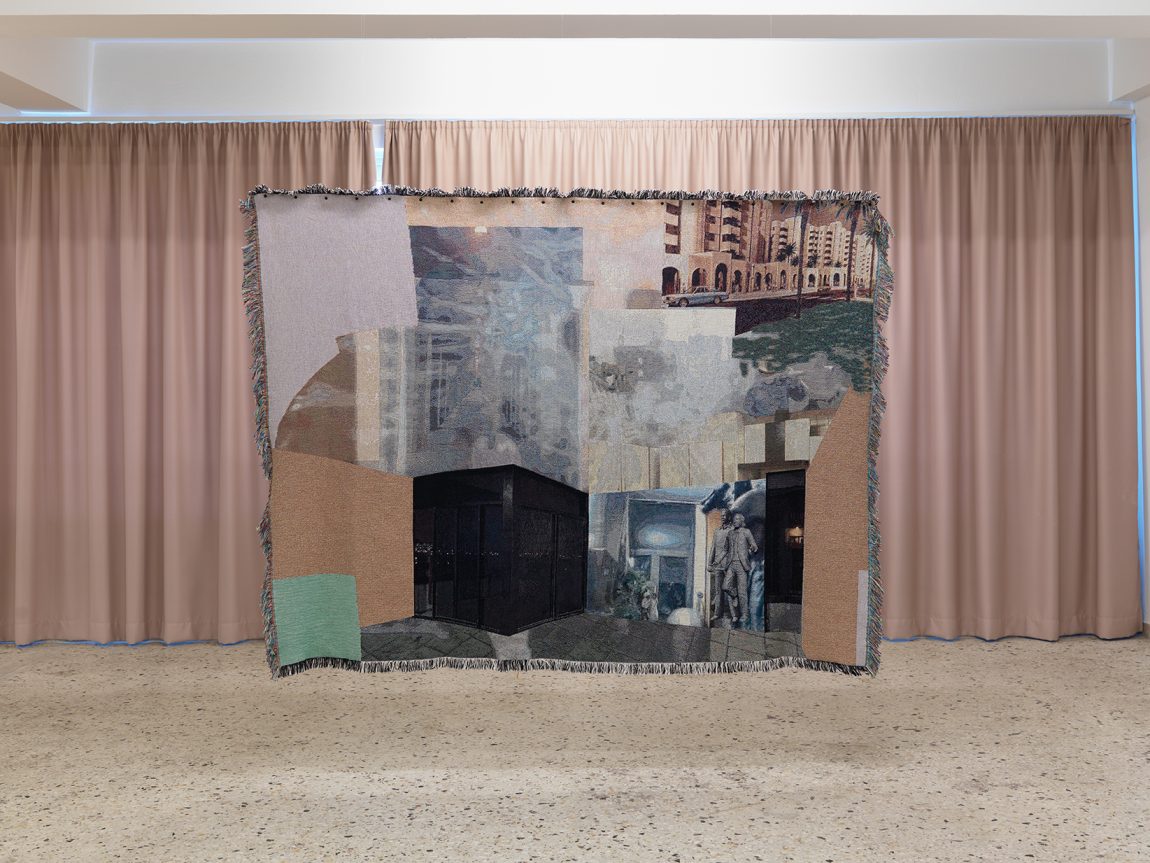
Battles in a Future Estate – Haifa Street, 2024. Jacquard cotton-woven textiles

Battles in a Future Estate – Haifa Street Walkthrough (phase 8), 2025. Wood structure, vinyl print

Between 1981 and 1985, six of the eight planned housing and institutional complexes rose on Haifa Street in Baghdad, despite the ongoing Iran–Iraq War. Conceived as part of a campaign to prepare the city for the 1982 Non-Aligned Movement summit, the street was envisioned as an exhibition of Iraq’s urban capacity. Initiated by Saddam Hussein, with architect Rifat Chadirji appointed as consultant to Baghdad’s Mayoralty, the Haifa Street model reverberated across Arab cities, though not its layered history of construction, deprivation, invasion, and restoration.

Battles in a Future Estate was a multi-iterative research and art project that returned to this history through the lens of exhibition. During construction in 1981, contractors were required to install on-site displays of building materials and standardized components—arguably the street’s first exhibitory moment. Subsequent forms of display emerged through artworks in public spaces and the (former) Saddam Centre for the Arts, the dispersal of private libraries and art collections during the sanctions of the 1990s, and the public exposure of domestic interiors raided by US military and video recorded between 2004 and 2008. The project mobilized these moments to trace how Haifa Street was repeatedly staged, viewed, and reframed over time.

The works presented spans different iterations of the project and included a video lecture recorded by the artist in 2021 connecting the vastly different four decades of this street’s history; two woven textiles produced in 2024 that imagine exhibitions at the Center for the Arts; and a wooden structure representing a scaled-down constellation of façades from the eighth phase of the Haifa Street project.

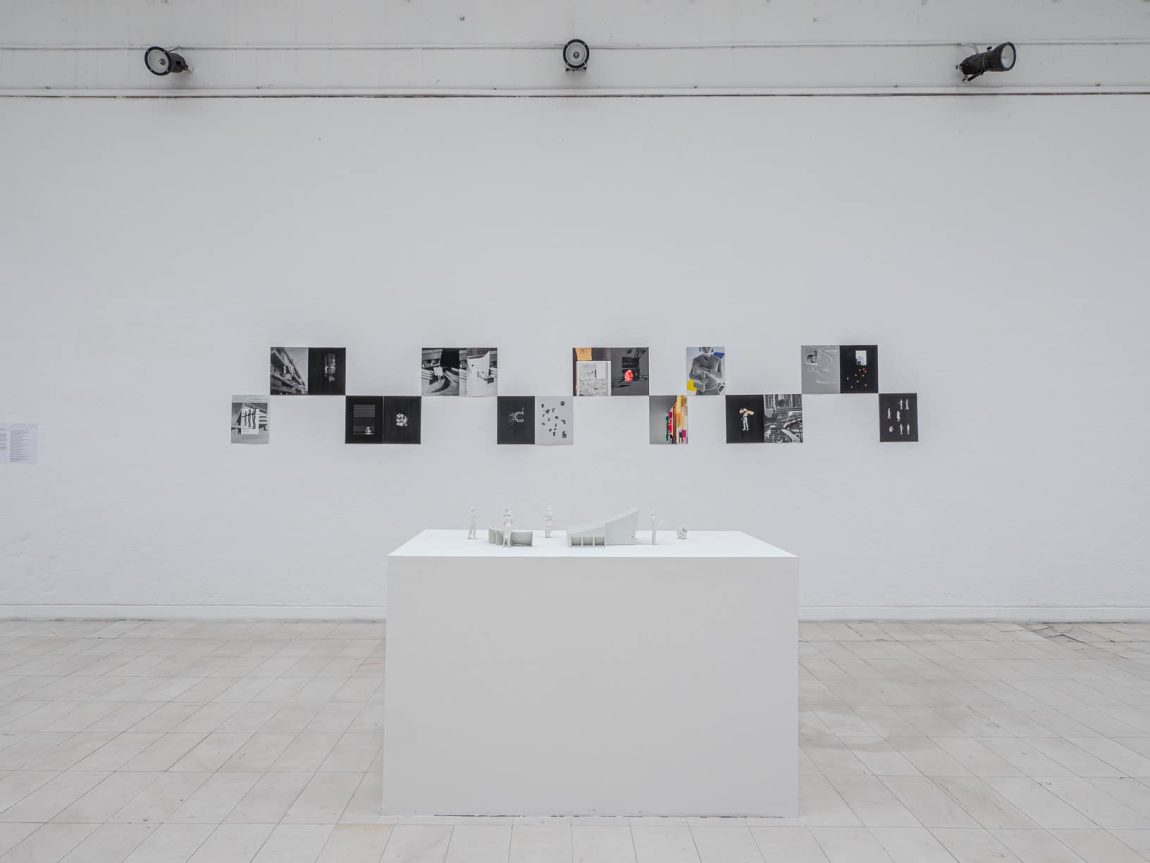
Plan (fem.) for Greater Baghdad, 2018.

Baghdad and Her Architects, 2018
Two- and three-dimensional prints and plastic model

This special project emerged as an experiment on presenting consolidated plates from Plan (fem.) for Greater Baghdad (2018), which in turn was another experiment based on the Plan for Greater Baghdad (2015), first commissioned for the central exhibition at the 56th Venice Biennale.

In the first iteration of her project, Plan for Greater Baghdad (2015), Younis created a timeline of events explaining how a gymnasium in Baghdad was designed by Le Corbusier and named after Saddam Hussein. Heavily based on archives, found materials, and the stories of its male protagonists, the project explored issues related to the protection of monuments for posterity and the creation of plans for Baghdad as either expressions of power or practical necessities. The faint presence of women in the materials and resources published on this history became the subject of the project’s subsequent phase.

In Plan (fem.) for Greater Baghdad (2018), Younis brought to the fore the significant contributions made by female artists, architects, and other key figures to the development of Baghdad and its modern monuments. Typical of Younis’s investigative practice, the work rearticulated archival material to produce new narratives. In this case, the reading moved beyond the male dominance of the city’s architecture and politics to reveal the influence of women on Baghdad’s history.

Among the female figures featured in this research were Ellen Jawdat, the Baghdad-based, Harvard-trained American architect whose work in Baghdad inspired an early wave of local architects; Balkis Shararah, Rifat Chadirji’s wife, who carried manuscripts of his work in and out of Abu Ghraib prison between 1979 and 1980, enabling him to author three books while incarcerated; architect Wijdan Maher, who designed and led prominent architectural projects across Iraqi cities and published an architecture-focused quarterly; artist Nuha al-Radi, whose diaries from 1991 described the dynamics of life in Baghdad beyond news coverage; architect Nada Zebouni, who, in her final year of architectural studies, interned at Le Corbusier’s contractor’s office in Paris and worked on the drawings and model for the gymnasium; and Zaha Hadid, whose architectural drawings sparked the imagination of architectural students in the 1990s.

Through found materials, documents, and oral histories, these stories were presented in the form of a timeline punctuated by inkjet prints and drawings, alongside digitally sculpted and 3D-printed models of different figures, which mirrored the 2015 male edition of the work.


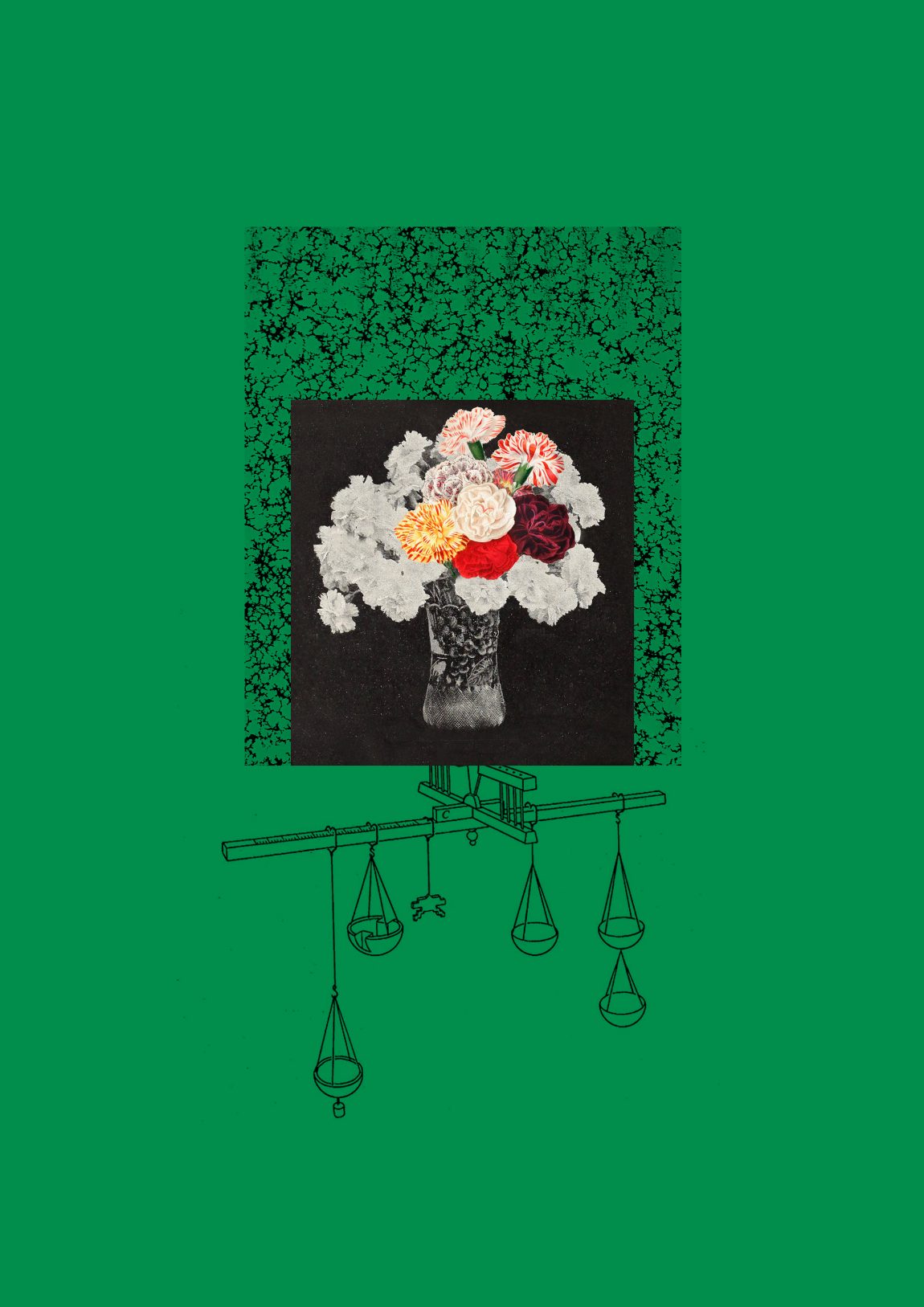
Trading Fragility, 2026. Prints on paper

Trading Fragility, 2026
Prints on paper

In her project Cut Flowers (2025), Younis examines the perishable supply chain of fast-paced flower cultivation, harvesting, and trade. The project began with extensive research into the cut-flower industry in the Gaza Strip between 1991 and 2012, tracing the movement of flowers and attending to press images that carried stories of flowers, and of people, halted at checkpoints. One photograph shows a group of young boys offering colorful carnations grown commercially near the Rafah crossing to pilgrims stranded at the border in 2002.

In their many forms and formations, they surface in reports and accounts as they travelled across languages, geographies, and markets for centuries. Their names have shifted and adapted with each new place and grower. Carnations appeared in the hands of religious figures in European art, and in the hands of admirals and political leaders in Ottoman one. 

Equally striking is the history of commercial carnation cultivation in late nineteenth- and early twentieth-century Europe and the United States, where time and transport technology limited newly bred types to travel from one place to another before they weathered. 

This series of diagrams draws on business and logistical tools developed over centuries yet meeting / meaning specific things in the present. The borrowed mechanisms are here imagined to have sustained a trade in cut flowers in, and despite, political and environmental interruption.